Introducing Monlam STT
State-of-the-Art Tibetan ASR

Intro
Despite recent advances in artificial intelligence, many languages around the world remain underrepresented in modern AI systems, including the Tibetan language. But here at Monlam AI, we have set it as our goal to ensure the Tibetan language is paced alongside the latest advancements in the world of tech. One of the pillars of our research is development of speech recognition technology for Tibetan.
Developing this speech-to-text technology carries significant meaning as it directly impacts the preservation and digital inclusion of the language. A robust speech-to-text technology opens the door to a plethora of possibilities and brings a new dimension to the accessibility of the language.
Today we introduce the new Monlam Speech-To-Text v4, available in monlam.ai as one of the AI tools for user application. It’s our most capable and efficient STT model to date, beating all the previously available Tibetan ASR models.
ཡ་ཨ་མའི་གཅེས་ཕྲུག་གཉིས་ཀ་ཤོག་ཤོག་ཤོག ལོ་ཆུ་འཐུང་ང་དོངས་ང་དི་ནས་ད་ཀ་ར་ཟོ་ཡ། ད་ལོ་ཆུ་འཐུང་དགོས་ནི་རེད། ཤོག་ར་ཨ་མ་གིས་གཏོ་མ་གཏོལ་ཡས་འོ་ཇ་བསྐོལ་བཞག་ཡོད་ཡ། ཨ་མའི་ལོ་ལོ་གཉིས་ཀ་གན་ནས་ཙོག་ག་དོངས།
Why Tibetan ASR is challenging
Developing Tibetan Automatic Speech Recognition (ASR) presents several unique challenges.
Choosing the right model architecture for Tibetan. Tibetan is deeply diglossic — the way people speak in everyday conversation diverges sharply from how the language is written, because the orthography preserves classical spellings that no longer match modern pronunciation. In practice, transcribing colloquial speech into readable written Tibetan is closer to a light translation/normalization task than a straight phonetic transcription. This is a real problem for a purely CTC-based model like wav2vec2, whose monotonic, alignment-based objective maps acoustic frames to output tokens roughly in order and has no mechanism for reordering, inserting, or rewriting tokens. It can learn the sound-to-symbol mapping, but it struggles when the target text isn't a near-linear reflection of the audio. Sequence-to-sequence / attention-based models (e.g. Whisper-style encoder-decoders) that can absorb a degree of implicit translation are better suited to bridging Tibetan's spoken–written gap.
First, there is a severe scarcity of speech data available for transcription and training. Second, there is no widely adopted standard for transcribing Tibetan speech, making it difficult to create consistent training data. Third, the lack of established benchmark datasets makes it challenging to measure and compare model performance. Fourth, the wide diversity of TIbetan dialects makes it difficult to build one system that works well for all speakers.
Finally, there are very few existing Tibetan speech-to-text systems, leaving limited prior work or reference models to guide development.
To overcome these obstacles we implemented comprehensive strategies to standardise Tibetan audio transcription and created the required data from scratch. Various Tibetan language experts contributed to create the transcription standards. Audio data from diverse sources were rigorously collected, preprocessed, and then meticulously transcribed by a dedicated team with a two layered review process before being finalised as part of the training dataset.
With this process, we have thus far managed to create about 2400 hours of quality Tibetan speech corpus, and continuously strive to produce even more.
Introducing the Model
Monlam STT v4 is our latest tool that can convert Tibetan speech into written text, helping users transcribe conversations, lectures, media content, and other audio materials. It is an automatic speech recognition (ASR) model displaying robust performance in all three dialects of Amdo, Utsang and Kham. In our internal evaluations and real-world testing, the model demonstrates strong transcription quality across a wide range of everyday use cases.
We also introduce a variation of the latest model — Monlam STT v4 Live, which enables real-time transcription. This particular variation loses some performance in the widely spoken Utsang dialect but achieves significant improvements in the Kham and Amdo dialect transcription.
Press play to see live transcription
Performance on Benchmark
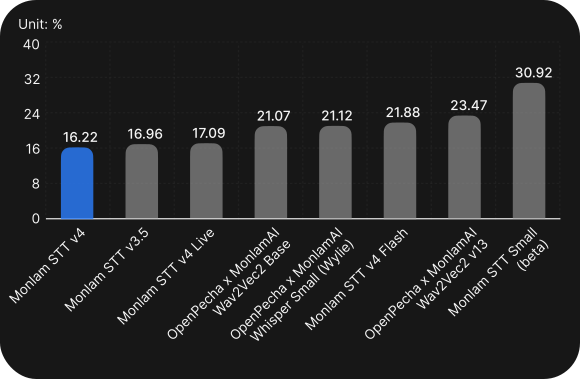
We evaluated Monlam STT using the newly released bo-voice-v2.1.0 benchmark, a comprehensive Tibetan ASR evaluation dataset covering different speakers, dialects, and audio conditions. Read more about Bo voice v2.1.0 here. All of the currently available Tibetan ASR models were evaluated on this standardized methodology and the latest Monlam STT v4 proved superior across all the categories. The most significant improvement was the performance for all three dialects compared to only being viable in the Utsang dialect in most of the previous models.
The new line of models using a more efficient foundation and trained on a much larger corpus show significant improvement over the previous line of models. Monlam’s latest STT model achieved a 23% relative CER improvement compared to the best model of the previous generation, i.e. the OpenPecha x MonlamAI Wav2Vec2-Base. For a low resource language such as Tibetan, achieving a CER below 20% is an excellent result and we will strive to improve it further in coming iterations to match industry benchmarks of high resource languages.
Overall CER ranking
Monlam STT v4
Monlam STT v3.5
Monlam STT v4 Live
OpenPecha x MonlamAI
Wav2Vec2 Base
OpenPecha x MonlamAI
Whisper Small (Wylie)
Monlam STT v4 Flash
OpenPecha x MonlamAI
Wav2Vec2 v13
Monlam STT Small (beta)
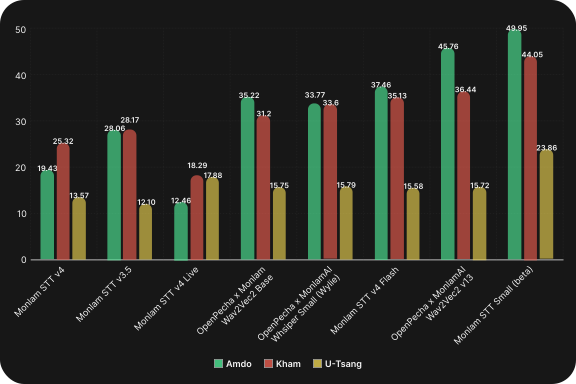
The benchmark test also evaluated the models on their performance in each of the respective dialects and the latest Monlam STT v4 again showed significant improvement over the previous models. It achieved 13.5% CER in Utsang dialect which makes it comparable to industry standard ASR for other low resource languages, while showing meaningful progress in the Amdo and Kham dialects as well.
Per-dialect CER (same ranking as overall)
Monlam STT v4
Monlam STT v3.5
Monlam STT v4 Live
OpenPecha x MonlamAI
Wav2Vec2 Base
OpenPecha x MonlamAI
Whisper Small (Wylie)
Monlam STT v4 Flash
OpenPecha x MonlamAI
Wav2Vec2 v13
Monlam STT Small
(beta)
Limitation and Future Work

The major limitation currently is its availability through and integration only into web applications that are developed by our team. In the near future, we will provide this technology as an API, along with our other models, through a dedicated platform — Melong AI Studio, thus making it accessible for everyone to use and integrate in their own applications.
Performance continues to improve for Amdo and Kham dialects as more high-quality training data becomes available. We are actively working to increase the corpus of quality data which directly translates to a better model. We strive not only to produce a satisfactory ASR system for a low resource language, but to bring the Tibetan language to match the industry standard and the rest of the world.
Monlam STT represents another significant step toward making Tibetan language technology accessible to everyone. We will continue improving our models and building tools that help Tibetan thrive in the digital age.
Availability

Monlam Speech-To-Text (STT) is available for free usage for everyone on our web application monlam.ai.